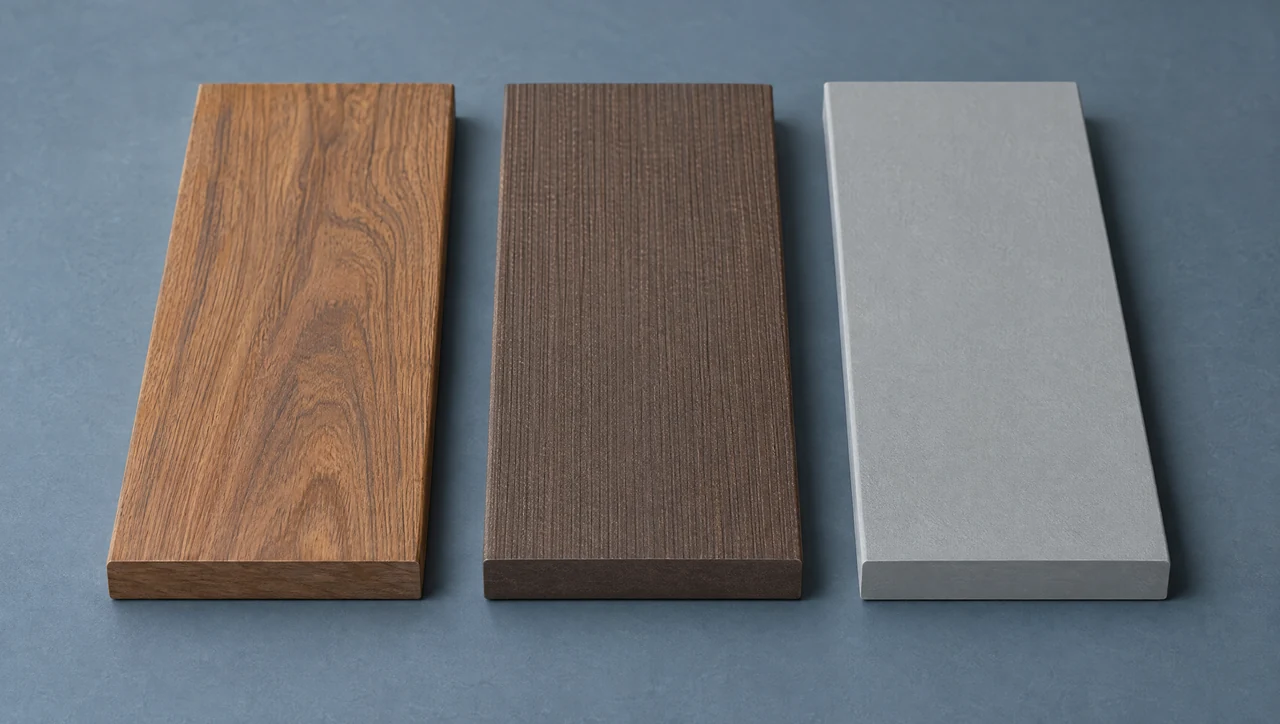
Keep a sample record
Label each sample with supplier, product line or species, grade, profile, color, finish and date received. If a field is missing, keep it visibly unresolved. Photograph the label alongside the sample for your records. A surface sample can help with appearance preferences; it cannot establish the identity of a later shipment or prove installation compatibility.
Compare the same supply scope
Ask whether each quotation includes boards, attachment accessories and any special edge pieces. Keep nominal and actual dimensions separate. A substitution that changes the profile or product line reopens the evidence review, even if its trade name sounds similar. The output of this step is three traceable candidate identities, not three family labels.
A category is the beginning of a comparison
“Hardwood,” “composite” and “PVC” describe broad material groups. They do not identify a supplied board's profile, dimensions, finish, installation requirements or permitted uses. A useful comparison begins with a named product or a sufficiently defined wood specification in each column.
Within one category, two products can differ in section, surface, fastening options and documented applications. Avoid transferring a claim from a premium line to every product sold by the same manufacturer. For wood, identify the supplied species, milling, grade or appearance basis and condition rather than treating the species name as a complete order description.
Build a product identity card
Use the same fields for every candidate. A blank field is a question to resolve, not a reason to fill in a favorable assumption. Keep the product name and document revision visible so a later substitution does not quietly inherit the first candidate's evidence.
| Identity field | What to enter |
|---|---|
| Manufacturer or supplier | Party responsible for the supplied product |
| Product or material description | Exact line, species specification or SKU where available |
| Actual section | Thickness, width, profile and installed coverage basis |
| Surface | Color, texture, coating or intended unfinished condition |
| Installation document | Current instructions for the proposed application |
| Supporting evidence | Reports or data tied to that exact product |
The ICC-ES explanation of evaluation reports shows why product identification and conditions of use matter when that type of evidence is involved. A report number should lead to a document you can inspect, not act as a decorative approval badge.
Make samples represent the order
Label each sample and keep its identity with the comparison. Confirm whether it represents the proposed profile and finish. A small display chip may show color but not edge geometry, surface texture across a full board or natural variation within a wood shipment.
For wood, review several representative pieces if appearance variation is important. For manufactured products, confirm the exact color and surface line. View samples in the location's light rather than comparing one under a warm lamp and another outdoors.
Once identities are stable, use the project priorities guide to decide which differences matter. A detailed table of products still produces a poor decision if it compares attributes that have little relevance to the intended deck.
A change in decking priorities
Two candidates both say “composite.” One product record is incomplete until its exact line and installation document are supplied, so the worksheet keeps it unresolved.
Hypothetical planning example.
Technical context
USDA’s historical WPC research describes different formulations and polymers. A polymer name alone does not establish a wood-free board.
USDA: Durability of wood-plastic composite lumber